Peter and Eva’s Journey to Conceive and Fertility Treatment
Nieuwe burenPeter and Eva’s Journey to Conceive and Fertility Treatment begins with a promise intended to answer one loss and becomes a prolonged test of love, bodily autonomy, and the limits of hope. Their effort moves from intimate, optimistic attempts at conception to clinical procedures and a donor-conceived child, Lieve, whose death leaves Peter and Eva grieving not only their daughter but also the future they had been trying to build.
A promise made in bereavement
The decision to try for a child comes the day after Peter’s mother’s funeral. His father had died six months earlier, and Peter, now feeling orphaned, mourns the absence of a sibling with whom he could share memories of their parents. Eva tells him that she cannot replace such a person, but promises instead to give him a family. She flushes her contraceptive pill, and Peter agrees, although he later admits he did not know whether he truly wanted a child. What reassured him was the prospect of being with Eva forever and the fact that she wanted to carry his child.
Their first year of trying has the intensity of a new beginning. They have sex almost daily and imagine that each encounter may have made them parents. Moonlight falling across Eva’s body becomes, for Peter, a sign that a conception has taken place; the next day’s nausea can seem to confirm it. Repeated Predictor tests dispel those hopes. Even when they think they see a faint second line, bleeding follows. Their longing is fed by small signs, then repeatedly returned to uncertainty.
From private effort to scheduled sex
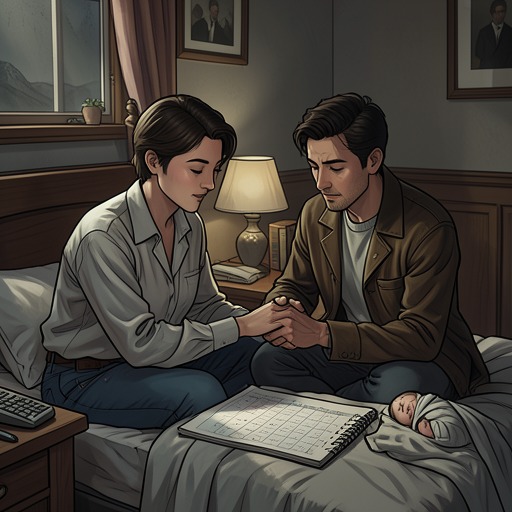
After a year, their family doctor declines to refer them to a gynecologist. He tells them that many couples are still not pregnant after a year and sees no reason for alarm given their age and health. He recommends that they help nature by tracking Eva’s temperature. The advice turns intimacy into a routine governed by a chart: Eva takes her temperature at 6:30 each morning, and a rise of 0.2 degrees Celsius is treated as a likely sign of approaching ovulation. On those mornings, sex becomes hurried and functional, squeezed in before work rather than sought for pleasure or closeness.
Six months later, the strain surfaces in a serious argument about entering fertility treatment. Peter resists the medical route because he wants a child conceived through love rather than from a test tube. He also misses the relationship they had before sex became organized around ovulation and ejaculation. Eva feels abandoned by his reluctance. She shares his dislike of their mechanical sex life, but believes it will change once she is pregnant; she also wants to know whether a treatable problem is preventing conception. The next morning, they obtain a referral.
The diagnosis and the medical route
Five weeks later, a gynecologist examines Eva. The initial tests show no obvious abnormalities: her temperature chart indicates monthly ovulation, and an ultrasound reveals no blockages, cysts, or inflammation in her uterus or ovaries. Their blood is tested, and Peter is asked to provide a semen sample after five days without ejaculation. He recalls the embarrassment of masturbating in a small, dark room and handing the sample to a nurse. Three weeks later he repeats the procedure.
Both semen analyses reach the same conclusion. Peter has too few sperm, and the sperm present move poorly. The discovery relocates the problem from Eva’s body, which had so far borne the physical demands of trying, to Peter’s own infertility. It also makes assisted treatment their remaining route to a child. In later years, their attempts accumulate to nine IVF procedures, four ICSI treatments, and five KID attempts. The scale of that effort becomes central to Peter’s eventual insistence that they have reached a limit.
Lieve and the end of the attempts
The treatment journey results in the birth of Lieve, conceived with a donor. Peter later describes her as a daughter who was not biologically his, and recalls hating the unknown donor. Her death makes the distinction between genetic and parental connection part of an already devastating loss: Peter and Eva had scarcely survived losing Lieve, and the burial also marked, in his view, the burial of their dream of another child.
Their grief does not proceed in step. At Lieve’s grave, Eva tends the flowers while Peter waters the forget-me-nots and holds her hand. He is ashamed to recognize his jealousy of her intense grief and of the dead baby who remains the focus of her love. At another visit, he places a white rose by the stone and struggles to feel love for a child he never had the chance to know. Eva, by contrast, fears that not thinking about Lieve means forgetting her; the photograph of their daughter and the memory of her body remain essential to her identity as a mother. These scenes make the end of treatment more than a medical decision: it is bound up with two different experiences of parenthood and mourning.
After treatment: choice and consequence
In a later account of their conflict, Peter says that he could no longer watch Eva’s healthy body suffer for his infertility. After nine IVF attempts, four ICSI treatments, and five KID attempts, he believes they have reached their limit; he recalls that Eva had also asked him to protect her from beginning again. For him, Lieve’s burial made the boundary unmistakable. Eva’s question about why he would not continue trying shows how differently they understand that boundary: for her, stopping means surrendering the possibility of a child; for him, continuing risks repeating a loss they barely survived.
The desire for a child later enters a different and more ethically fraught territory. Rebecca proposes that Eva and Steef arrange sex around Eva’s ovulation and allow a condom to fail, calling the plan soft coercion. After a condom incident, Steef brings Eva a morning-after pill and says he does not want another child; he describes Sem as having arrived against his will and doubts his own stability as a father. He later accuses Eva and Rebecca of stealing his sperm with his wife’s consent. This is no longer the clinical process Peter and Eva once entered together: the question of who gets to choose, and who bears the consequences, has shifted to the man whose reproductive consent was bypassed. The contrast underscores how their original longing for parenthood, once organized around shared hope and medical intervention, continues to shape choices long after the treatments themselves have ended.